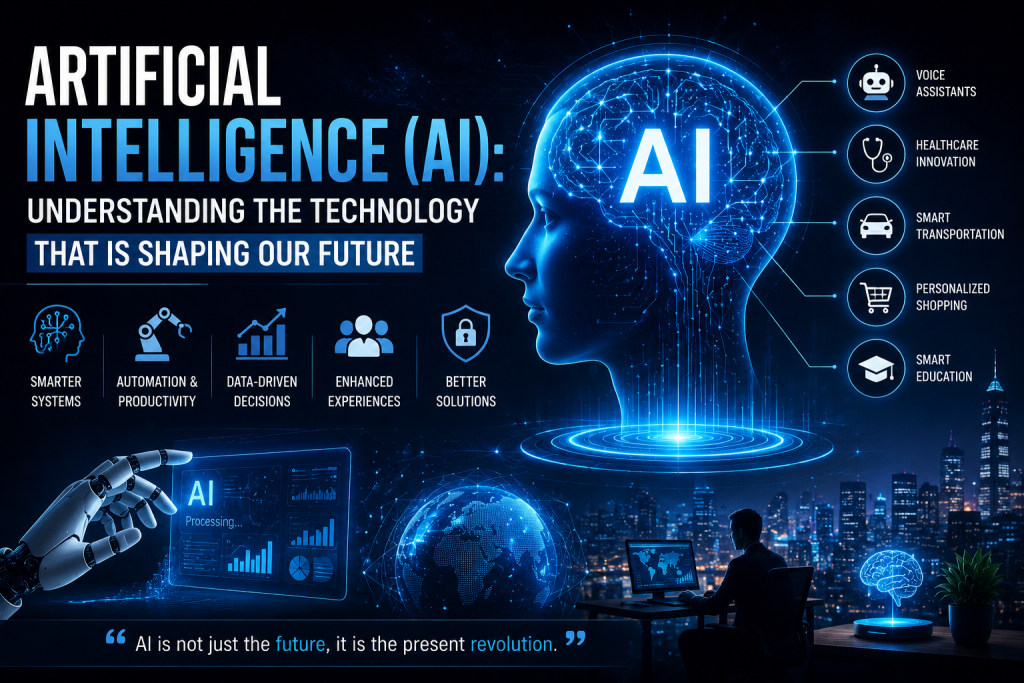
Artificial Intelligence (AI) is no longer a futuristic concept confined to science fiction. It has become an integral part of our daily lives, influencing how we communicate, work, learn, travel, and make decisions. From voice assistants such as Siri and Google Assistant to recommendation systems on YouTube and Netflix, AI is quietly transforming the way we interact with technology. As organizations and governments increasingly adopt AI-driven solutions, understanding its fundamentals has become essential for students, professionals, and decision-makers alike.
What is Artificial Intelligence?
Artificial Intelligence refers to the ability of computer systems to perform tasks that normally require human intelligence. These tasks include learning from experience, understanding language, recognizing images, solving problems, making decisions, and even generating creative content.
Unlike traditional software, which follows predefined instructions, AI systems can analyze data, identify patterns, and improve their performance over time. This ability to learn and adapt is what makes AI fundamentally different from conventional computer programs.
AI can generally be categorized into three levels:
Artificial Narrow Intelligence (ANI): Designed to perform specific tasks, such as facial recognition, language translation, spam detection, or virtual assistance. Almost every AI application used today belongs to this category.
Artificial General Intelligence (AGI): A theoretical form of AI capable of performing any intellectual task that a human can accomplish. AGI remains under active research and has not yet been achieved.
Artificial Super Intelligence (ASI): A hypothetical stage where AI surpasses human intelligence across all domains. While often discussed in research and philosophy, ASI remains speculative.
How Does AI Work?
At its core, AI works by combining data, algorithms, and computing power.
The process typically begins with collecting large volumes of data from various sources such as websites, sensors, business systems, medical records, or user interactions. This data is then cleaned and prepared to ensure accuracy and consistency.
Next, AI algorithms analyze the data to discover patterns and relationships. These algorithms are based on mathematical models that enable computers to make predictions or decisions.
One of the most important branches of AI is Machine Learning (ML). Instead of explicitly programming every rule, developers provide data, and the machine learns from examples. For instance, if thousands of images labeled “cat” and “dog” are used for training, the system gradually learns to distinguish between the two.
A more advanced branch is Deep Learning, which uses artificial neural networks inspired by the structure of the human brain. Deep learning has significantly improved AI’s ability to recognize speech, understand natural language, identify objects in images, and generate human-like text.
Modern AI systems generally follow these steps:
1. Collect data.
2. Process and clean the data.
3.Train an AI model using learning algorithms.
4. Test and validate the model.
5. Deploy the model in real-world applications.
6. Continuously improve the model using new data and user feedback.
The quality of an AI system largely depends on the quality of the data used during training. Poor or biased data often leads to inaccurate or unfair outcomes.
Real-Wrold Applications of AI
AI has become a driving force across almost every industry.
In healthcare, AI assists doctors in diagnosing diseases, analyzing medical images, predicting patient risks, and accelerating drug discovery.
In banking and finance, AI detects fraudulent transactions, evaluates credit risk, automates customer service through chatbots, and supports investment analysis.
In education, AI powers personalized learning platforms, automated grading systems, virtual tutors, and intelligent content recommendations.
In business, organizations use AI for customer support, demand forecasting, marketing automation, inventory management, and business intelligence.
In cybersecurity, AI monitors network traffic, identifies suspicious behavior, detects malware, and responds to cyber threats more quickly than traditional methods.
Even in our daily lives, AI is present in search engines, navigation systems, social media feeds, online shopping recommendations, language translation, and smart home devices.
Challenges and Ethical Considerations?
Despite its remarkable capabilities, AI also presents significant challenges.
One major concern is data privacy. AI systems often require large amounts of personal data, making secure data handling essential.
Another issue is algorithmic bias. If training data contains social or historical biases, AI may unintentionally produce unfair or discriminatory decisions.
The rapid growth of AI has also raised concerns about job displacement. While AI automates repetitive tasks, it is also creating demand for new roles involving AI development, management, cybersecurity, data science, and digital transformation. History suggests that technological progress changes the nature of work more often than it eliminates work entirely.
Transparency is another challenge. Many advanced AI models operate as “black boxes,” making it difficult to explain how certain decisions are reached. For sectors such as healthcare, finance, and law, explainability and accountability are increasingly important.
To maximize AI’s benefits, governments, technology companies, and educational institutions must collaborate to establish ethical standards, responsible governance, and effective regulatory frameworks.

The Future of AI
The future of AI is both exciting and transformative.
Over the next decade, AI is expected to become deeply integrated into nearly every aspect of society. Intelligent digital assistants will become more capable, autonomous vehicles will continue to mature, and AI-powered robots will support industries ranging from manufacturing to healthcare.
Generative AI is already changing how people create software, write documents, design graphics, analyze data, and conduct research. Rather than replacing human creativity, AI is increasingly serving as a powerful assistant that enhances productivity and enables professionals to focus on higher-value work.
Future AI systems are likely to become more multimodal, meaning they will seamlessly understand and generate text, images, audio, video, and even complex scientific data. At the same time, researchers are working to make AI more trustworthy, explainable, secure, and energy-efficient.
For countries like Nepal, AI presents significant opportunities to improve education, agriculture, healthcare, public services, disaster management, and digital governance. However, realizing these benefits will require investment in digital infrastructure, skilled professionals, quality data, and responsible AI policies.
Final Thoughts
Artificial Intelligence is one of the most influential technologies of the 21st century. It is reshaping industries, transforming economies, and redefining how people interact with information and technology. Understanding what AI is, how it works, and where it is heading is no longer optional-it is becoming an essential digital skill.
Rather than viewing AI as a replacement for human intelligence, we should see it as a powerful tool that complements human expertise. Those who continuously learn, adapt, and develop AI-related knowledge and skills will be better prepared to thrive in an increasingly intelligent and digitally connected world. The future will not simply belong to those who use AI, but to those who understand it and apply it responsibly to solve real world problems.